

Thursday, November 30, 2006


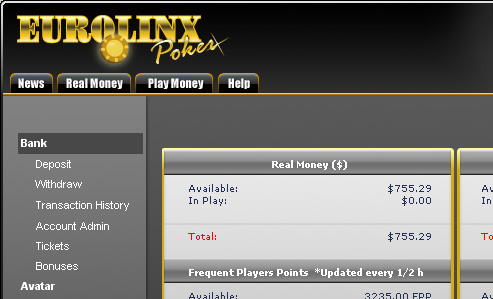
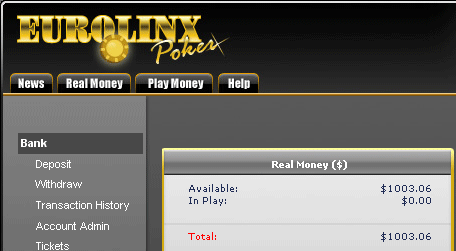
Well, that was easy! I turned 100$ into 1000$ in about 5 days on Eurolinx (including clearing a 100$ bonus).
 There's no question I hit some very lucky hands in my last two sessions and that is what accelerated my journey. Having said that, I also believe I've learned some key lessons about playing against the typical Eurolinx opponent and about myself that will make beating this site on a continual basis a reality for me.
Here are some of the lessons this challenge has taught me.
1. Pride is a Powerful Motivator
Previously on Eurolinx I have let myself go on tilt and play recklessly because the fact that I was losing to players who clearly have no idea what they are doing injured my pride. Now, because of this challenge, and the knowledge that I would have to post my results publicly for all of my friends and poker acquaintances to see, I was able to play better and avoid going on tilt. Having to post that I had failed would do far more damage to my pride than losing to a Eurodonk. So, even when I lost a buy-in because of some moron, I continued to play my best. If I found myself playing badly and unable to focus, I simply left the table and shut down the software.
2. There is a Big Difference Between .25/.50 and .50/1.00 on Eurolinx
I was surprised to find that such a small jump in stakes had such a dramatic effect on the game play. The .50/1.00 players are much more aggressive and are not as easy to run over. I found myself having to play a lot tighter and bluff significantly less at the .50/1.00 level. Having said that, you could still describe my style at .50/1.00 as loose aggressive, but I pick my spots more carefully. At .25/.50 I was raising practically every hand, that simply did not work at .50/1.00.
3. No Limping Unless You Have a Small Pair
The only reason to ever limp in preflop is to go set mining. If you don't have a pair in your hand, you should never limp in to the pot. It's a losing strategy. I don't care how many people have limped before you or how great you think your "odds" are. Preflop, without a pair, you must raise or fold. With a small pair pre-flop, limp or call a standard raise only if you are getting implied odds of 10 to 1 (mathematically this is more than you need, but it helps compensate for the rare situations where you hit a set and still lose).
4. Pot Control is Key
You need to be dictating the size of the pot in every hand. You keep the pot small, unless you have a big hand at which point you make the pot big. If your opponent makes the pot big when you need to keep it small, just fold. This is by no means a revolutionary concept, it has been covered to death everywhere, but it is especially relevant on Eurolinx. The players there seldom make big bets without having what they perceive to be a strong hand. They will call you down with their draws and mid-pairs, etc... But most of the time if you bet or check they are happy to just go along with you and not raise.
That's it for now. I'm tired and I need to work in the A.M. I will try to post some hands and analyse them in light of what I have learned when I get the chance. The hand converter I use is down right now, so it may be a while. In any case, you can expect me to use this blog to set goals and post my progress, hopefully that will keep me focused and improve my results.
 There's no question I hit some very lucky hands in my last two sessions and that is what accelerated my journey. Having said that, I also believe I've learned some key lessons about playing against the typical Eurolinx opponent and about myself that will make beating this site on a continual basis a reality for me.
Here are some of the lessons this challenge has taught me.
1. Pride is a Powerful Motivator
Previously on Eurolinx I have let myself go on tilt and play recklessly because the fact that I was losing to players who clearly have no idea what they are doing injured my pride. Now, because of this challenge, and the knowledge that I would have to post my results publicly for all of my friends and poker acquaintances to see, I was able to play better and avoid going on tilt. Having to post that I had failed would do far more damage to my pride than losing to a Eurodonk. So, even when I lost a buy-in because of some moron, I continued to play my best. If I found myself playing badly and unable to focus, I simply left the table and shut down the software.
2. There is a Big Difference Between .25/.50 and .50/1.00 on Eurolinx
I was surprised to find that such a small jump in stakes had such a dramatic effect on the game play. The .50/1.00 players are much more aggressive and are not as easy to run over. I found myself having to play a lot tighter and bluff significantly less at the .50/1.00 level. Having said that, you could still describe my style at .50/1.00 as loose aggressive, but I pick my spots more carefully. At .25/.50 I was raising practically every hand, that simply did not work at .50/1.00.
3. No Limping Unless You Have a Small Pair
The only reason to ever limp in preflop is to go set mining. If you don't have a pair in your hand, you should never limp in to the pot. It's a losing strategy. I don't care how many people have limped before you or how great you think your "odds" are. Preflop, without a pair, you must raise or fold. With a small pair pre-flop, limp or call a standard raise only if you are getting implied odds of 10 to 1 (mathematically this is more than you need, but it helps compensate for the rare situations where you hit a set and still lose).
4. Pot Control is Key
You need to be dictating the size of the pot in every hand. You keep the pot small, unless you have a big hand at which point you make the pot big. If your opponent makes the pot big when you need to keep it small, just fold. This is by no means a revolutionary concept, it has been covered to death everywhere, but it is especially relevant on Eurolinx. The players there seldom make big bets without having what they perceive to be a strong hand. They will call you down with their draws and mid-pairs, etc... But most of the time if you bet or check they are happy to just go along with you and not raise.
That's it for now. I'm tired and I need to work in the A.M. I will try to post some hands and analyse them in light of what I have learned when I get the chance. The hand converter I use is down right now, so it may be a while. In any case, you can expect me to use this blog to set goals and post my progress, hopefully that will keep me focused and improve my results.
Labels: Eurolinx, Eurolinx Challenge, Online Poker
posted by Bill Sparks at 12:39 AM
2 comments