


Wednesday, November 29, 2006


Well, clearing my bonus and turning 100$ into 500$ playing .25/.50 was remarkably easy once I set my mind to it. I deposited 100$ on Saturday the 25th and by Monday the 27th I had cleared my bonus and there was just over 500$ in my account. Here's how I did it:
It turns out that the .25/.50 stake on Eurolinx is generally populated by loose-passive players. Early on, I believed the correct strategy for beating Eurolinx was to engage in "nut peddling". Effectively, this entails playing very tight, betting your hands and never bluffing. I quickly realized that at the tables I was playing, my opponents were making all of their decisions based solely on the perceived strength of their own hand. They never considered what I might have (beyond thinking that any preflop raise means AK). They also paid no attention to table image and did not adjust their game to counteract any particular opponent's style or strategy. This lead me to the conclusion that the proper strategy to beat these games was to simply raise and c-bet as often as possible.
In position, I would make it 4 units to go with any two cards. If I got heads up to the flop, I would c-bet 6 units and usually take it down. If I got to the flop with 2 other players, my c-bet would change to 8 units. If I got involved with more than two opponents on the flop, I would not c-bet unless I had a legitimately strong hand. Generally speaking if and when anyone played back at me, I would fold. This worked well and I found myself winning a whole lot of small pots.
The other major attribute about many Eurolinx opponents is that they tend to perceive strong draws as really valuable hands. This fact, seems to have contributed to my past failures on the site. So I spent a lot of time thinking about and experimenting with good counter strategies for this. What I came up with is one of the keys to beating Eurolinx, at least from my perspective. Here are the basic principles:
These principles lead me to the following conclusion:
It feels weird to check behind on the turn when I think my opponent is on a draw and missed. But if I myself have not made any kind of hand, there is no point in betting since my fold equity is generally non-existent at this point. When my opponent misses the river, I will be in a position to make a reasonably sized bet (relative to the pot) without committing too many chips and since there are no more cards coming, my opponent can not call. If my opponent hits his draw on the river I can simply fold and by not betting on the turn, I've saved some money. Also, when I have position, my opponent will generally bet into me if he stumbled onto a pair on the river by accident at which point I can also fold and lose minimum.
Of course, if I have a strong hand and I believe my opponent is drawing, I MUST bet the turn. This builds the pot for me and creates value for when my opponent misses the river (which he will more often than not).
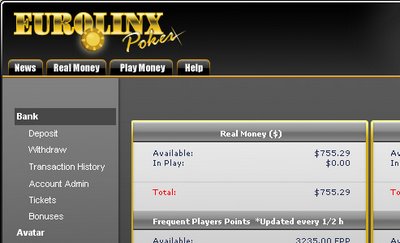
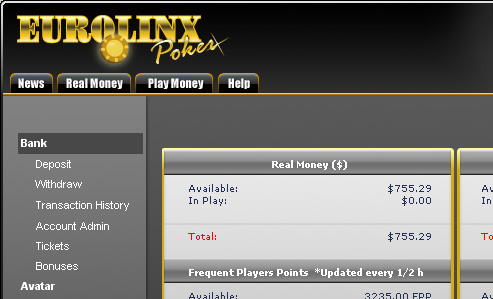
So, armed with this strategy, I made short work of my first objective and I have started playing .50/1.00. After a good session tonight, my account is up to just over 750$.
It turns out that the .25/.50 stake on Eurolinx is generally populated by loose-passive players. Early on, I believed the correct strategy for beating Eurolinx was to engage in "nut peddling". Effectively, this entails playing very tight, betting your hands and never bluffing. I quickly realized that at the tables I was playing, my opponents were making all of their decisions based solely on the perceived strength of their own hand. They never considered what I might have (beyond thinking that any preflop raise means AK). They also paid no attention to table image and did not adjust their game to counteract any particular opponent's style or strategy. This lead me to the conclusion that the proper strategy to beat these games was to simply raise and c-bet as often as possible.
In position, I would make it 4 units to go with any two cards. If I got heads up to the flop, I would c-bet 6 units and usually take it down. If I got to the flop with 2 other players, my c-bet would change to 8 units. If I got involved with more than two opponents on the flop, I would not c-bet unless I had a legitimately strong hand. Generally speaking if and when anyone played back at me, I would fold. This worked well and I found myself winning a whole lot of small pots.
The other major attribute about many Eurolinx opponents is that they tend to perceive strong draws as really valuable hands. This fact, seems to have contributed to my past failures on the site. So I spent a lot of time thinking about and experimenting with good counter strategies for this. What I came up with is one of the keys to beating Eurolinx, at least from my perspective. Here are the basic principles:
- I want to encourage my opponent to draw with bad, yet seemingly attractive pot odds when I feel I have them beat.
- Just because I know my opponent is on a draw and misses the turn, it doesn't mean that I can bet him off his hand. In his mind he still has a shot.
- Sometimes my opponent is not on a draw, even though I may believe s/he is.
- Even when an opponents intended draw misses, they may still hit a card and make a pair that beats you.
These principles lead me to the following conclusion:
It is wrong to bluff into a perceived draw on the turn when your opponent has apparently missed.
It feels weird to check behind on the turn when I think my opponent is on a draw and missed. But if I myself have not made any kind of hand, there is no point in betting since my fold equity is generally non-existent at this point. When my opponent misses the river, I will be in a position to make a reasonably sized bet (relative to the pot) without committing too many chips and since there are no more cards coming, my opponent can not call. If my opponent hits his draw on the river I can simply fold and by not betting on the turn, I've saved some money. Also, when I have position, my opponent will generally bet into me if he stumbled onto a pair on the river by accident at which point I can also fold and lose minimum.
Of course, if I have a strong hand and I believe my opponent is drawing, I MUST bet the turn. This builds the pot for me and creates value for when my opponent misses the river (which he will more often than not).
So, armed with this strategy, I made short work of my first objective and I have started playing .50/1.00. After a good session tonight, my account is up to just over 750$.
Labels: Eurolinx, Eurolinx Challenge, Online Poker, Poker Strategy
posted by Bill Sparks at 2:38 AM
0 comments


 (t5315, 1 player + 1 all-in - Main pot: t5315)
 (t5315, 1 player + 1 all-in - Main pot: t5315)
 (t5315, 1 player + 1 all-in - Main pot: t5315)


 (t2430, 0 player + 2 all-in - Main pot: t4635)
 (t2430, 0 player + 2 all-in - Main pot: t4635)
 (t2430, 0 player + 2 all-in - Main pot: t4635)


 ($18, 3 players)
 ($98.8, 1 player + 1 all-in - Main pot: $98.8)


 ($226.8, 1 player + 1 all-in - Main pot: $226.8)
 ($226.8, 1 player + 1 all-in - Main pot: $226.8)